"I flood your image like a valley in spring rain. Where two lakes are about to merge, I build a dam. The dams are your boundaries; the lakes are your objects. You are welcome."
A Watershed Transform With a Flair for Hydrology
The watershed transform treats a grayscale image as a three-dimensional landscape, intensity is altitude, and segments it by simulating a flood rising from every valley at once. As the water rises, each valley becomes a growing lake (a catchment basin); the moment two lakes are about to merge, a dam is built between them, and those dams are the segment boundaries. The power of this idea is that it separates objects by the shape of the terrain, not by intensity similarity, which is exactly what region growing could not do. Run on the distance transform of a binary mask, watershed will split two touching coins or two abutting cells along the thin neck where they meet, the single most useful trick in the classical segmentation toolbox and still the default in cell-counting microscopy today.
Section 11.2 ended on a problem region growing cannot solve: two objects of the same intensity that touch present no boundary to grow up against, so a homogeneity predicate floods straight from one into the other. The watershed transform attacks this from a completely different angle. Instead of asking "are these pixels similar?" it asks "if water rose through this terrain, where would the ridges between basins fall?" Because the answer depends on the geometry of the surface rather than on absolute values, watershed can place a boundary exactly where two blobs pinch together, even when there is no intensity difference across the pinch at all. The trick is choosing the right surface to flood, and that choice connects directly to the morphological distance transform from Chapter 6.
1. The Topographic Metaphor Basic
Picture a grayscale image as a relief map: dark pixels are low ground, bright pixels are peaks. A regional minimum is a connected set of pixels surrounded by higher ground, the bottom of a valley. The catchment basin of a minimum is every pixel from which a drop of water would flow down into that minimum. The watershed lines are the ridges separating one basin from the next, the points where water is undecided about which valley to fall into. The illustration below makes the flooding-and-dams picture concrete.
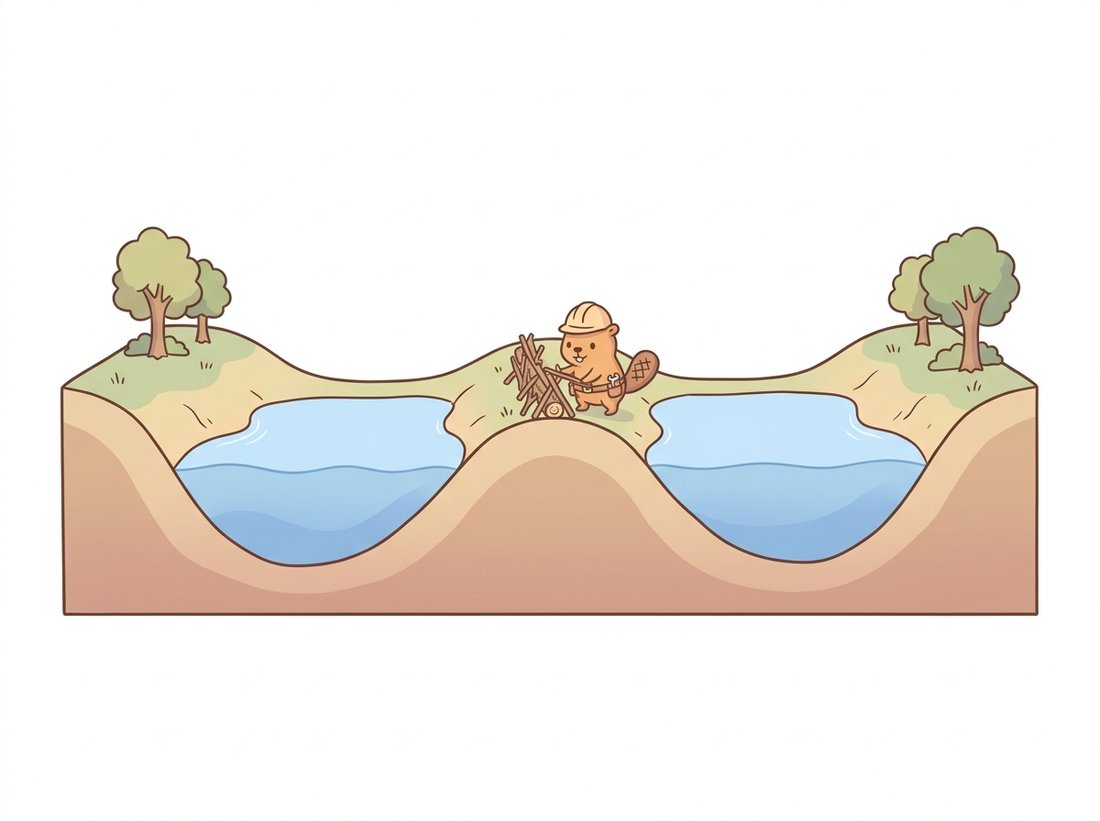
The immersion algorithm of Vincent and Soille (1991) builds these basins by simulating a flood. Imagine piercing a hole at each regional minimum and slowly immersing the whole landscape in water. Water wells up from each minimum, filling its basin. Whenever the water from two distinct basins would meet, a dam is erected at that location to keep them separate. When the entire surface is submerged, the dams that remain are the watershed lines, and the basins they enclose are the segments. Figure 11.3.1 shows this flooding for a one-dimensional intensity profile with two valleys.
Applied naively to a raw image, the surface to flood is usually the gradient magnitude, not the intensity itself, because object boundaries are where the gradient is high (ridges) and object interiors are where it is low (valleys). Flooding the gradient image puts watershed lines on the edges, which is what we want. The gradient comes straight from the Sobel operator of Chapter 3.
2. The Oversegmentation Problem Basic
There is a catch, and it is severe. Real images contain a regional minimum almost everywhere, because sensor noise creates thousands of tiny local dips. Since the immersion algorithm starts a basin at every regional minimum, naive watershed produces one segment per minimum, which means hundreds or thousands of segments where you wanted five. This is the notorious oversegmentation of the watershed, and it is so reliable that an unguided watershed is essentially never used in practice.
The watershed's strength and its weakness are the same property: it is exquisitely sensitive to local minima. That sensitivity is what lets it find the precise ridge between two touching objects, but it also means that a single noisy pixel, sitting one gray level below its neighbors, opens its own catchment basin and therefore its own segment. The number of segments a naive watershed returns is the number of regional minima in the surface, which for a real photograph is enormous. Every practical use of watershed is therefore really a strategy for controlling which minima are allowed to seed a basin. The two strategies are smoothing the surface (fewer minima) and, far more powerfully, supplying the minima by hand as markers.
The watershed metaphor is not borrowed loosely from geography; it comes straight from it. The word "watershed" is the line of high ground that decides which river basin the rain runs into, and the immersion algorithm literally simulates flooding a terrain. The pioneers of the digital version, Beucher and Lantuejoul, were working at a French mining-research center in the late 1970s, analyzing images of metal grains and ore samples under a microscope. The next time cv2.watershed separates two touching cells for you, it is running a hydrology simulation invented to count rocks.
3. Marker-Controlled Watershed Intermediate
The fix that makes watershed useful is marker-controlled watershed. Instead of letting every regional minimum seed a basin, you supply a small set of markers, one per object you want, plus one for the background, and force the flood to originate only from those markers. The result has exactly as many segments as you have markers (plus background), and the watershed lines fall on the ridges between marked regions. The genius is in how the markers are obtained for the touching-objects case, and it threads together three tools you already have:
- Threshold the image to a binary foreground mask (Otsu's method from Chapter 2 is the usual choice).
- Compute the distance transform of the foreground (from Chapter 6): each foreground pixel is labeled with its distance to the nearest background pixel. The center of each blob is a peak; the thin neck where two blobs touch is a valley.
- Threshold the distance transform high to get one sure-foreground marker per blob (the peaks survive, the neck does not), label them with connected components, and flood the negated gradient or the negated distance from those markers.
Because the distance-transform peak of each blob is separated by the low ridge at the neck, the markers are distinct, and watershed dams the flood exactly at the neck. This is the standard recipe for separating touching cells, coins, or grains, and Figure 11.3.2 illustrates why the distance transform turns the touching-objects problem into a watershed it can solve.
A common belief is that watershed splits two touching coins or cells because it floods the image intensity (or its gradient) and finds a wall between them. In fact, two same-colored objects pressed together present no intensity ridge at the neck at all, so flooding the intensity or the gradient runs straight from one object into the other and returns them as a single basin, exactly the failure region growing had in Section 11.2. What makes the split possible is flooding the negated distance transform: the distance-to-background dips to a saddle at the neck even when color does not change across it, so the geometry of the pinch (not any color difference) becomes the ridge that dams the flood. The rule to remember: watershed separates touching blobs only because the distance transform manufactures a boundary that the pixels themselves never had.
The OpenCV implementation, cv2.watershed, takes a marker image of 32-bit integer labels: positive integers for known regions, zero for "unknown" pixels to be assigned, and it writes -1 onto the watershed lines. Below is the complete coin-separation pipeline.
import cv2
import numpy as np

img = cv2.imread("coins.jpg")
gray = cv2.cvtColor(img, cv2.COLOR_BGR2GRAY)

# 1. Otsu threshold -> binary foreground (coins white, background black).
_, binary = cv2.threshold(gray, 0, 255, cv2.THRESH_BINARY_INV + cv2.THRESH_OTSU)

# 2. Clean the mask and find SURE background by dilating.
kernel = np.ones((3, 3), np.uint8)
opened = cv2.morphologyEx(binary, cv2.MORPH_OPEN, kernel, iterations=2)
sure_bg = cv2.dilate(opened, kernel, iterations=3)

# 3. Distance transform -> peaks are coin centers. Threshold high for sure FG.
# Keeping only pixels above half the max distance keeps each coin's deep center
# but drops the shallow neck where two coins touch, so the centers stay separate.
dist = cv2.distanceTransform(opened, cv2.DIST_L2, 5)
_, sure_fg = cv2.threshold(dist, 0.5 * dist.max(), 255, 0)
sure_fg = sure_fg.astype(np.uint8)

# 4. Unknown = background minus foreground; label markers with connected comps.
unknown = cv2.subtract(sure_bg, sure_fg)
n_markers, markers = cv2.connectedComponents(sure_fg)
markers = markers + 1               # so sure background is 1, not 0
markers[unknown == 255] = 0         # mark unknown region with 0

# 5. Flood. cv2.watershed writes -1 on the boundary ridges.
markers = cv2.watershed(img, markers)
img[markers == -1] = [0, 0, 255]    # paint watershed lines red

n_objects = n_markers - 1           # minus the background label
print("coins separated:", n_objects)
# coins separated: 24cv2.watershed to flood from the markers. The boundary ridges come back as -1 and are painted red.The chain of operations is worth pausing on, because every link is a tool from an earlier chapter: thresholding from Chapter 2, morphological opening and dilation and the distance transform from Chapter 6, connected components for marker labeling, and watershed itself to flood. The watershed is the climax, but it is the distance transform that does the conceptual heavy lifting, turning "two blobs that touch" into "two peaks separated by a valley" that the flood can resolve.
The marker-finding dance, threshold the distance transform, run connected components, build the integer marker image, is several careful lines and easy to get wrong (off-by-one label offsets, the unknown-region encoding). scikit-image packages marker detection and watershed into a cleaner pair:
import numpy as np
from scipy import ndimage as ndi
from skimage.segmentation import watershed
from skimage.feature import peak_local_max

dist = ndi.distance_transform_edt(binary_mask)            # distance transform
coords = peak_local_max(dist, min_distance=20, labels=binary_mask)
markers = np.zeros(dist.shape, dtype=int)
markers[tuple(coords.T)] = np.arange(1, len(coords) + 1)  # one label per peak
labels = watershed(-dist, markers, mask=binary_mask)      # flood the negated distance
print("objects:", labels.max())
# objects: 24watershed with peak_local_max marker detection, replacing the manual threshold-and-label marker construction with a single peak finder.The reduction is modest in line count but large in correctness: peak_local_max with a min_distance guard handles the "merge nearby peaks so one blob gets one marker" problem that a raw threshold of the distance transform does not, removing the most common source of residual oversegmentation. The library also accepts a compactness argument that biases basins toward convex shapes, a knob the OpenCV version lacks.
A pharmaceutical screening lab needed to count cultured cells in thousands of fluorescence-microscopy wells per day to measure how a candidate drug affected cell proliferation. The cells were bright on a dark background, so thresholding found the foreground easily, but cells in dense wells pressed against one another, and a plain connected-components count merged every cluster into one giant object, badly undercounting exactly the wells where the drug had the strongest effect. The analyst rebuilt the pipeline around marker-controlled watershed: threshold, distance transform, peak_local_max to seed one marker per cell, then flood.
The decisive parameter was min_distance in the peak finder, which encodes the smallest expected cell radius. Set too small, it split single large cells into halves; set correctly to the known cell size, it gave one marker per cell and watershed dammed the necks between touching cells cleanly. Validated against a biologist's manual counts on 200 wells, the automated count landed within three percent, and the throughput went from a few wells an hour by hand to thousands per minute. The lesson the team carried forward: watershed turned an uncountable pile into countable objects precisely because the distance transform encoded cell shape, and no amount of intensity tuning would have done the same.
The marker-controlled pipeline above is one short script away from a genuinely useful command-line tool: point it at a photo of touching blobs and it prints the count and saves an annotated image with each object outlined and numbered. Wrap the Otsu-threshold, distance-transform, peak_local_max, and watershed steps in a function, draw the contour of every label with cv2.findContours, and write the integer count near each centroid with cv2.putText. The same fifteen-line core counts cells in a microscopy crop, coins in a tray, pills on a tablet line, or seeds in a packet, because all four are blob-counting problems the distance transform turns into separable peaks. It is a small, self-contained portfolio piece that shows you can take a classical recipe from this section all the way to a finished tool, with the one tuning knob (the min_distance that encodes the smallest object radius) exposed as a flag. To go further, log the per-object area so the tool also reports a size histogram, the kind of measurement a real inspection line actually wants.
4. Where Watershed Fits, and Where It Hands Off Intermediate
Watershed earns its keep whenever objects are blob-like and the main difficulty is that they touch: cells, coins, grains, pills, bubbles, nuclei. Its weaknesses are equally specific. It struggles with elongated or branching objects whose distance transform has no single clean peak, with objects of wildly varying size (one min_distance cannot fit all), and with scenes where the gradient surface is noisy enough that even smoothing leaves spurious basins. And like every method in this chapter so far, it knows nothing about what an object is; it separates blobs whether or not they are meaningful.
There is one more conceptual gap. Watershed makes a hard, local commitment, the dam goes at the ridge, full stop, with no notion of a global cost that might prefer a slightly different cut. The next section, Section 11.4, replaces local commitment with global optimization: it writes the segmentation as the minimum of an energy over the whole image and solves it exactly for the two-region case. That global view is what finally lets a segmenter trade a little local boundary accuracy for a lot of global coherence, and it is the bridge to the learned segmentation of Chapter 24.
The watershed idea did not retire when networks arrived; it merged with them. The Deep Watershed Transform (Bai and Urtasun, CVPR 2017) trains a network to predict a watershed energy whose basins are object instances, turning instance segmentation into a single watershed cut and remaining a touchstone for instance-segmentation design. In modern microscopy, StarDist (Schmidt et al., 2018, with active 2023-2024 extensions to 3D and dense tissue) predicts star-convex polygons for nuclei and sidesteps watershed's elongation weakness, while Cellpose (Stringer et al., Nature Methods 2021, and the 2024 Cellpose 3 release) predicts spatial flow fields whose sinks act as learned watershed markers, generalizing across cell types without retraining. The throughline is striking: these systems keep watershed's flood-from-markers skeleton and replace the hand-built distance-transform markers with learned ones, exactly the classical-skeleton-with-learned-parts pattern this chapter keeps surfacing. Cell-counting labs that ran cv2.watershed a decade ago now run Cellpose, but the algorithm underneath is recognizably the same.
Explain in your own words why marker-controlled watershed floods the negated distance transform rather than the raw binary mask or the raw intensity. Specifically: (a) what role does negation play, (b) why does the distance transform's saddle point at the neck of two touching blobs end up as the watershed line, and (c) what would go wrong if you flooded the intensity image directly for the touching-coins case?
Take an image of touching objects (coins, beans, or the scikit-image data.coins() sample). Run the scikit-image watershed pipeline while sweeping min_distance in peak_local_max over a range from very small to very large. Plot the resulting object count against min_distance and mark the plateau where the count equals the true number. Discuss why the plateau exists and what it tells you about choosing the parameter without knowing the answer in advance.
For a natural image with textured regions (not blob-like objects), compare two watershed strategies: (a) flooding the Sobel gradient magnitude with no markers, and (b) the same but with markers placed at the regional minima of a heavily smoothed gradient. Count the segments each produces, overlay both boundary maps on the image, and write a paragraph explaining why the unmarked gradient watershed oversegments so badly and how smoothing-then-marking tames it. Relate your finding to the noise-sensitivity insight in this section.