"Tell me which way the density rises and I will climb it forever. That gradient is the only compass I have ever needed, and the only one I ever trusted."
A Score Function Pointing Uphill
Take the discrete DDPM steps to a continuous limit and the forward process becomes a stochastic differential equation; its time reversal is another SDE whose drift contains exactly one unknown quantity, the score of the noisy data distribution, which is the gradient of its log-density and which the denoiser already learns. This continuous view unifies DDPM with score matching from Chapter 30, classifies the design choices into two families (variance-exploding and variance-preserving), and reveals a deterministic twin of the noisy SDE: the probability-flow ODE, which carries the same distribution of samples without injecting any randomness. That ODE is the gateway to the fast samplers of the next section.
The DDPM of Section 33.2 is a discrete chain of $T$ steps. This section asks what happens as $T \to \infty$ and the steps become infinitesimal. If the stochastic calculus on the next few lines looks like a detour into unrelated math, here is the reason to push through: it ends with a small shock. The noise-prediction network you already trained in Section 33.1 turns out to be, up to a single rescaling, the score estimator from Chapter 30; you built two famous models at once without knowing it, and this section is where the disguise comes off.
The plan is to take that one shock apart into three results, each developed in its own subsection. First, the continuous limit turns the forward chain into a stochastic differential equation, and its time reversal contains exactly one unknown, the score function of Chapter 30, which is what reveals that your noise predictor was a score estimator all along. Second, there are two natural ways to set up the forward SDE (variance-exploding and variance-preserving), and naming them lets you read any model's configuration. Third, every diffusion model has a hidden deterministic counterpart, the probability-flow ODE, that the rest of the chapter relies on heavily for fast and reproducible sampling. Take the three in order and the stochastic-calculus notation stays grounded in objects you already built.
1. From Discrete Steps to a Continuous SDE Advanced
A stochastic differential equation describes how a quantity evolves under a deterministic push plus continuous random noise. Written in the standard form, the forward diffusion is
where $f(x, t)$ is the drift (a deterministic vector field pulling the sample somewhere), $g(t)$ is the diffusion coefficient (how much noise is injected per unit time), and $dW$ is the increment of a Wiener process, the continuous-time analogue of adding a fresh Gaussian at each step. The DDPM update from Section 33.2, $x_t = \sqrt{1-\beta_t}\,x_{t-1} + \sqrt{\beta_t}\,z$, is exactly the Euler discretization of such an SDE; in the limit of small steps it becomes a specific $f$ and $g$. The forward SDE is not learned. The whole point is what happens when you reverse it.
2. The Reverse SDE and the Score Advanced
A 1982 result by Anderson states that any forward SDE has a time-reversed SDE, and gives its form explicitly. The reverse of the equation above is
where $p_t(x)$ is the distribution of noisy samples at time $t$ and $d\bar W$ is a reverse-time Wiener increment. Everything in this equation is known except one term: $\nabla_x \log p_t(x)$, the score, the gradient with respect to the image of the log-density of noisy data. This is the same score you met in the energy-based models and score matching of Chapter 30; there it was the gradient that Langevin dynamics climbed, here it is the only unknown standing between us and a generator. If we can estimate the score at every noise level, we can simulate the reverse SDE and turn noise into data. Figure 33.3.1 shows how the forward SDE flattens a structured density into a Gaussian and the reverse SDE, steered by the score, rebuilds it. The illustration below makes the score concrete as a compass that always points uphill toward the data.
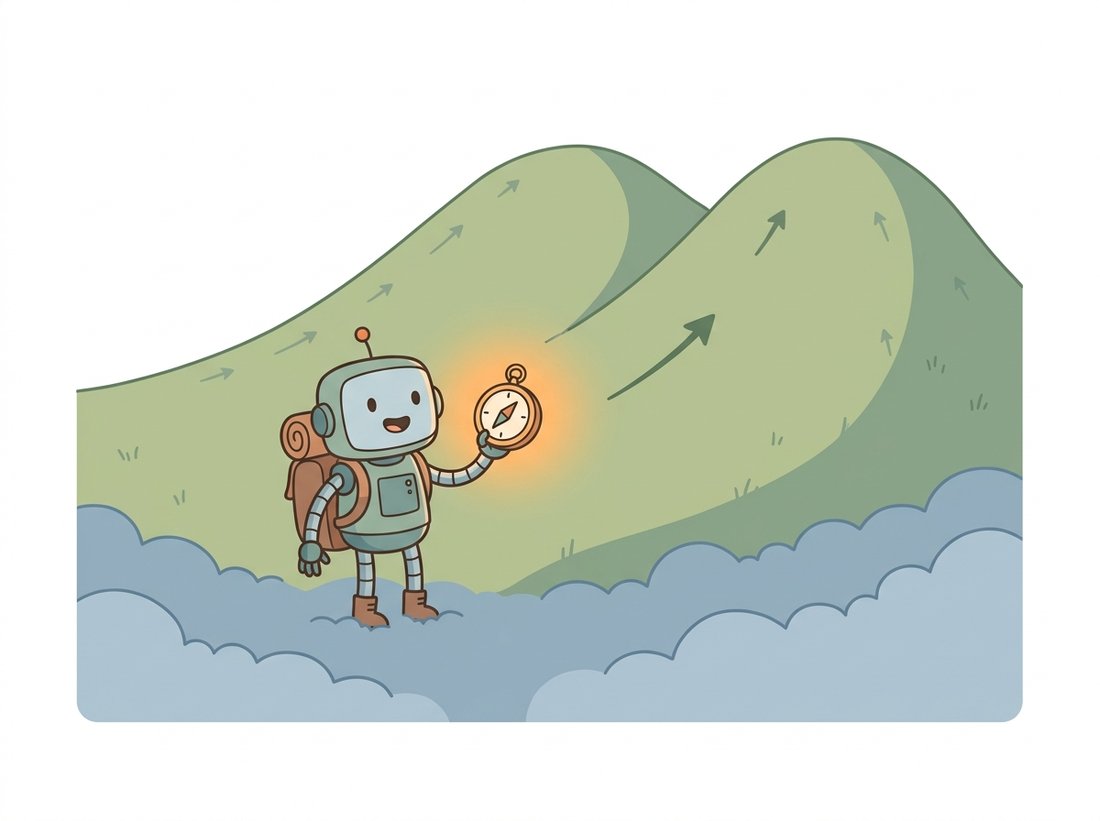
For the Gaussian forward process, the score of the noisy distribution has a closed-form relationship to the added noise: $\nabla_x \log p_t(x_t) = -\,\epsilon / \sqrt{1 - \bar\alpha_t}$, where $\epsilon$ is the noise that produced $x_t$. So the noise-prediction network $\epsilon_\theta$ from Section 33.1 and a score network $s_\theta$ are the same object up to a fixed rescaling: $s_\theta(x_t, t) = -\,\epsilon_\theta(x_t, t) / \sqrt{1 - \bar\alpha_t}$. You did not train a new kind of model in this chapter; you trained the score estimator of Chapter 30, just with the clever closed-form corruption that made the targets cheap to compute. This identity is the bridge between the variational view of DDPM and the score-matching view, and it is why both communities ended up at the same algorithm.
2b. VE and VP: Two Ways to Add Noise Advanced
The forward SDE has two canonical instantiations, distinguished by what they do to the total variance of $x_t$.
- Variance Exploding (VE): the drift is zero and the noise scale $g(t)$ grows without bound, so $x_t = x_0 + \sigma(t)\,\epsilon$ with $\sigma(t)$ rising to a very large value. The variance "explodes" because nothing shrinks the signal; corruption is achieved by drowning it in ever-larger noise. This is the formulation of the original score-matching models, the noise conditional score network (NCSN).
- Variance Preserving (VP): the drift shrinks the signal as noise is added, exactly the $\sqrt{1-\beta_t}$ factor of DDPM, so the total variance stays near one throughout. DDPM is the discrete VP SDE.
The two are related by a simple change of variables and produce equivalent models, but they differ in numerical conditioning and in how the noise levels are chosen, which is why a sampler written for one needs care to apply to the other. The EDM framework of Section 33.2 reparameterizes both in terms of a single noise scale $\sigma$, which is the cleanest way to hold them in one head. The practical upshot: when you read that a model uses a "VP schedule" it is a DDPM-style process; "VE" means the NCSN-style explode-the-variance process; and EDM's $\sigma$-parameterization subsumes both.
3. The Probability-Flow ODE Advanced
Here is the result that the rest of the chapter leans on. For every forward SDE there exists an ordinary differential equation, with no noise term at all, whose solution trajectories have the same marginal distributions $p_t(x)$ at every time as the noisy SDE. It is called the probability-flow ODE:
Compare this to the reverse SDE in subsection 2: the score appears again, but the noise injection $g(t)\,d\bar W$ is gone and the score term carries a factor of one half instead of one. Because there is no randomness, this ODE defines a deterministic, invertible map between a noise sample and a data sample. Two consequences make it central. First, deterministic trajectories are smooth, so you can solve them with large, accurate steps using standard ODE solvers, which is the entire basis of fast sampling in Section 33.4. Second, the map being invertible means you can run it forward to encode a real image into its corresponding noise, the foundation of the inversion-based editing you will meet in Chapter 35. The code below solves the probability-flow ODE for the trained 2D denoiser using a simple Euler integrator over the $\sigma$-schedule.
# Deterministic sampling via the probability-flow ODE.
# No noise is drawn inside the loop: at each step we predict x0 from the
# rescaled score, then move to the next lower noise level on a coarse grid.
import torch

@torch.no_grad()
def pf_ode_sample(model, alpha_bars, n=512, steps=50, T=200):
    """Deterministic sampling by Euler-integrating the probability-flow ODE."""
    x = torch.randn(n, 2)                                   # start from noise
    ts = torch.linspace(T - 1, 0, steps).long()             # coarse time grid
    for i in range(len(ts) - 1):
        t, t_next = ts[i], ts[i + 1]
        ab, ab_next = alpha_bars[t], alpha_bars[t_next]
        eps = model(x, t.repeat(n))                         # eps_theta = score (rescaled)
        # predict x0, then move deterministically toward the next (lower) noise level
        x0_hat = (x - (1 - ab).sqrt() * eps) / ab.sqrt()
        x = ab_next.sqrt() * x0_hat + (1 - ab_next).sqrt() * eps
    return x

# samples = pf_ode_sample(model, alpha_bars)   # 50 deterministic steps, no torch.randn inside
print("probability-flow ODE: deterministic, ~50 steps instead of 200")pf_ode_sample function integrates the probability-flow ODE deterministically with an Euler step over a coarse 50-point time grid. Unlike the ancestral sampler of Section 33.1, no fresh noise is drawn inside the loop, so the same starting point always yields the same output. This determinism, plus the smoothness of the ODE, is what lets us use far fewer steps; this update rule is exactly DDIM, which Section 33.4 derives.The probability-flow ODE makes a diffusion model into a continuous normalizing flow, the deterministic invertible generators studied separately in the flow literature. For a while the score-based and flow-based communities published in parallel without realizing how close their objects were. The SDE paper's appendix quietly noted the connection, and within a year "diffusion" and "continuous flow" had largely merged into one research conversation. The flow-matching of Section 33.5 is the full reconciliation.
Who: an ML platform team at a media company shipping a generative-image feature, 2024. Situation: their legal group required that every image the product generated could be exactly reproduced from a stored seed and prompt, for audit and takedown purposes. Problem: their initial pipeline used the stochastic ancestral sampler, which draws fresh noise at every step, so even with a fixed seed, framework and hardware differences in the RNG produced slightly different images, breaking reproducibility. Decision: they switched the production sampler to a deterministic probability-flow ODE solver (DDIM, the subject of Section 33.4), which draws randomness only once to form the initial noise and is fully deterministic thereafter. Result: given the same initial latent, the pipeline reproduced byte-stable outputs across machines, satisfying the audit requirement, and as a bonus the deterministic sampler needed only 30 steps instead of the stochastic sampler's hundreds. Lesson: the SDE-versus-ODE choice is not only about speed; the determinism of the probability-flow ODE is a product requirement in any setting that needs reproducibility, and it comes essentially for free.
Hearing that the probability-flow ODE injects no randomness, learners often conclude it must collapse to a single image, or that the stochastic SDE explores the data distribution while the ODE samples only a sliver of it. Neither is true. The theorem behind the ODE is precisely that it shares the same marginal distribution $p_t(x)$ as the SDE at every time, so over many runs the two produce equally diverse, equally on-distribution samples. The determinism is only per trajectory: a fixed starting noise yields a fixed image, but the variety across generations comes entirely from drawing a different initial noise tensor $x_T$, not from the per-step randomness. This is why deterministic DDIM sampling (Section 33.4) does not reduce the range of images a text-to-image model can produce; it just makes each seed reproducible. The per-step noise of the SDE changes the path taken, not the distribution of endpoints reached.
The continuous SDE and ODE framing (Song et al., 2021, arXiv:2011.13456) turned out to be the language in which nearly all subsequent progress was expressed. The EDM design space (Karras et al., 2022) is stated entirely in $\sigma$-space SDE/ODE terms. The flow-matching and rectified-flow methods of Section 33.5 (Lipman et al., 2023; Liu et al., 2023) are about choosing a better probability path and learning its ODE velocity field directly. Consistency models (Song et al., 2023) are defined as learning the solution map of the probability-flow ODE. Even diffusion-based solvers for inverse problems (deblurring, super-resolution, MRI reconstruction in 2023 to 2025) plug a measurement-consistency term into the reverse SDE. If you internalize one idea from this section, make it that the reverse-time SDE and its deterministic ODE twin are the substrate on which the modern field reasons.
4. The Forward SDE in Full: VE and VP Kernels Advanced
Subsection 2b named the two families; a graduate course needs their exact drift, diffusion, and transition kernels, because those closed forms are what you actually simulate and what the loss is computed against. Start again from the general forward SDE, now written with the Wiener increment as $dw$ to match the primary source (Song et al., 2021):
A linear SDE of this form has a Gaussian transition kernel $p_{0t}(x_t \mid x_0) = \mathcal N(x_t; \mu_t(x_0), \Sigma_t)$, whose mean and covariance solve a pair of ordinary differential equations (the moment equations of the SDE). We solve those for each family.
4.1 Variance Exploding (VE)
The VE SDE is the continuous limit of the score-matching models (SMLD/NCSN), in which corruption is pure noise injection with no shrinkage of the signal. It sets the drift to zero and chooses the diffusion coefficient so that the running variance tracks a prescribed schedule $\sigma^2(t)$:
With zero drift the mean does not move, so $\mu_t(x_0) = x_0$. The variance accumulates the squared diffusion coefficient: $\frac{d}{dt}\Sigma_t = g(t)^2 I = \frac{d}{dt}\sigma^2(t)\, I$, which integrates to $\Sigma_t = [\sigma^2(t) - \sigma^2(0)]\, I$. The transition kernel is therefore
The name is now literal: as $t$ grows, $\sigma(t)$ is driven to a very large value, so the variance explodes while the mean stays pinned at $x_0$. The signal is never attenuated; it is simply drowned. Sampling from this kernel is one line, $x_t = x_0 + \sqrt{\sigma^2(t) - \sigma^2(0)}\,\epsilon$ with $\epsilon \sim \mathcal N(0, I)$, which is exactly the multi-scale noise corruption of NCSN.
4.2 Variance Preserving (VP) and Recovering DDPM
The VP SDE is the continuous limit of DDPM. Here the drift actively shrinks the signal as noise is added so the total variance is held near one, which is what makes the inputs to the network stay on a fixed scale across all noise levels. With a noise-rate schedule $\beta(t) > 0$,
This is a linear SDE with $f(x,t) = -\tfrac12 \beta(t) x$ and $g(t) = \sqrt{\beta(t)}$. The mean obeys $\frac{d}{dt}\mu_t = -\tfrac12 \beta(t)\mu_t$, a scalar linear ODE whose solution is an exponential decay, and the variance obeys $\frac{d}{dt}\Sigma_t = -\beta(t)\Sigma_t + \beta(t) I$, a linear ODE driven toward the identity. Solving both with $\mu_0 = x_0$ and $\Sigma_0 = 0$ gives the closed-form marginal
The mean decays toward zero and the variance rises toward one, so their squares always sum to one (in the per-coordinate, unit-data-variance sense): the variance is preserved. Deriving these two formulas from the SDE is Exercise 33.3.4. The intuition behind the $-\tfrac12 \beta x$ drift is precisely this balance: the exponent on the mean is half the exponent on the variance, which is what forces $\mu_t^2 + \Sigma_t = 1$.
Discretize the VP SDE with the Euler-Maruyama scheme on a unit time grid, replacing $\beta(t)\,dt$ with the per-step value $\beta_i$. The update becomes $x_i = x_{i-1} - \tfrac12 \beta_i x_{i-1} + \sqrt{\beta_i}\, z \approx \sqrt{1 - \beta_i}\, x_{i-1} + \sqrt{\beta_i}\, z$, using $\sqrt{1-\beta_i} \approx 1 - \tfrac12\beta_i$ for small $\beta_i$. This is the DDPM forward step of Section 33.2 verbatim, with $\alpha_i = 1 - \beta_i$ and $\bar\alpha_i = \prod_{j=1}^{i} \alpha_j$. The continuous marginal variance $1 - e^{-\int_0^t \beta(s)ds}$ is the continuous-time counterpart of the discrete $1 - \bar\alpha_i$, and the mean factor $e^{-\frac12\int_0^t \beta(s)ds}$ is the counterpart of $\sqrt{\bar\alpha_i}$. The continuous and discrete pictures are the same process viewed at two resolutions.
5. Deriving the Reverse-Time SDE and Its Training Objective Advanced
Subsection 2 stated Anderson's reverse-time SDE; here is what it says and how the single unknown becomes a tractable regression target. Anderson (1982) proved that if a process evolves forward by $dx = f(x,t)\,dt + g(t)\,dw$, then running time backward the same marginals $p_t$ are reproduced by another diffusion:
where $d\bar w$ is a Wiener increment for time flowing in reverse (an infinitesimal Gaussian as $t$ decreases from $T$ to $0$), and $\nabla_x \log p_t(x)$ is the score of the noisy marginal. Read the drift term by term: $f(x,t)$ is the original forward push, which in reverse time still acts, and $-g(t)^2 \nabla_x \log p_t(x)$ is the correction that bends trajectories back uphill toward regions of high data density. The diffusion coefficient $g(t)$ is unchanged from the forward process; only the drift acquires the score.
Every quantity here is known except the score $\nabla_x \log p_t(x)$, because $p_t$ is the marginal of the data pushed through the forward SDE and we have no closed form for it. We learn a network $s_\theta(x, t)$ to approximate it. The marginal score is intractable, but the per-sample conditional score $\nabla_{x_t} \log p_{0t}(x_t \mid x_0)$ is available in closed form (it is the Gaussian kernel of subsection 4), and a classical identity (Vincent, 2011) shows that regressing onto the conditional score also fits the marginal score in expectation. The training objective is weighted denoising score matching:
The outer expectation samples a time $t$ (uniformly or from a chosen distribution), $\lambda(t) > 0$ is a positive weighting that balances the loss across noise levels, $x_0$ is drawn from data, and $x_t$ is drawn from the forward kernel given $x_0$. For the VP kernel the conditional score is $\nabla_{x_t}\log p_{0t}(x_t\mid x_0) = -(x_t - \mu_t)/\Sigma_t = -\,\epsilon/\sqrt{1-\bar\alpha_t}$, which is precisely the noise-prediction target of Section 33.1 up to the $1/\sqrt{1-\bar\alpha_t}$ rescaling of the Key Insight in subsection 2. Choosing $\lambda(t) = \Sigma_t$ (the kernel variance) turns this objective into the plain noise-prediction MSE that DDPM minimizes. The same loss, two weightings, two communities.
6. Deriving the Probability-Flow ODE from Fokker-Planck Advanced
Subsection 3 wrote the probability-flow ODE down and described its consequences; the course needs the derivation, which is a short and elegant manipulation of the Fokker-Planck equation. The point to establish is that a deterministic flow can reproduce the exact same time-varying density $p_t$ as the noisy SDE, with no randomness at all.
Any SDE $dx = f(x,t)\,dt + g(t)\,dw$ induces a partial differential equation for how its marginal density $p_t(x)$ evolves, the Fokker-Planck (forward Kolmogorov) equation. With a scalar diffusion coefficient $g(t)$ it reads
The first term is transport by the drift and the second is diffusion (a Laplacian smoothing). The trick is to rewrite the diffusion term as the divergence of a flux so the whole right-hand side becomes a single divergence, which is the signature of a deterministic transport (continuity) equation. Use the identity $\nabla^2 p_t = \nabla\cdot(\nabla p_t)$ and the log-derivative identity $\nabla p_t = p_t\, \nabla \log p_t$:
Substituting back and pulling both terms under one divergence,
This is exactly the continuity (Liouville) equation $\partial_t p_t + \nabla\cdot(\tilde f\, p_t) = 0$ for particles carried by the deterministic velocity field
A continuity equation says: if you move every particle along the ODE $\frac{dx}{dt} = \tilde f(x,t)$, the population density they carry evolves by precisely this PDE. Since that PDE is identical to the Fokker-Planck equation of the original SDE, the deterministic flow and the stochastic process share the same marginals $p_t(x)$ at every time. That deterministic flow is the probability-flow ODE:
The single most common mistake when implementing these equations is using the wrong coefficient on the score term. The reverse-time SDE carries the full $g(t)^2\, \nabla_x \log p_t(x)$; the probability-flow ODE carries $\tfrac{1}{2}\, g(t)^2\, \nabla_x \log p_t(x)$, exactly half. The half is not a convention you may drop: it is what the Fokker-Planck derivation forces, because moving the diffusion term into the drift contributes only half of $g^2$ to the deterministic velocity (the other half is what the SDE realizes as injected noise). Use $g^2$ in an ODE solver and your samples drift off-distribution; use $\tfrac12 g^2$ in the SDE and you under-correct. When in doubt, check which equation has a $d\bar w$ noise term (then the score factor is $g^2$) and which does not (then it is $\tfrac12 g^2$).
6.1 Exact Likelihoods via the Instantaneous Change of Variables
Because the probability-flow ODE is a deterministic, invertible map, it is a continuous normalizing flow, and continuous normalizing flows come with an exact likelihood. Along an ODE trajectory the log-density evolves by the instantaneous change-of-variables formula:
Integrating this from $t = 0$ to $t = T$ along the trajectory that starts at a data point $x_0$ gives $\log p_0(x_0)$ as the known Gaussian log-density at $x_T$ minus the accumulated divergence. The one obstacle is that the divergence $\nabla\cdot\tilde f$ is a trace of a $d\times d$ Jacobian, expensive for image-sized $d$. The Hutchinson trace estimator replaces it with a stochastic estimate $\nabla\cdot\tilde f = \mathbb E_{v}[\, v^\top \partial_x \tilde f\, v\,]$ for $v$ with identity covariance (for example Rademacher or standard Gaussian), and $v^\top \partial_x \tilde f$ is a single vector-Jacobian product cheaply obtained by automatic differentiation. This is how the SDE paper reports exact bits-per-dimension likelihoods for diffusion models, a number GANs cannot produce at all.
Given a trained score network $s_\theta(x, t) \approx \nabla_x \log p_t(x)$, the drift $f$, the diffusion $g$, and a data point $x_0$:
- Form the ODE velocity $\tilde f_\theta(x, t) = f(x, t) - \tfrac{1}{2} g(t)^2\, s_\theta(x, t)$.
- Draw a fixed probe vector $v$ with $\mathbb E[v v^\top] = I$ (Rademacher or Gaussian) for the Hutchinson estimator.
- Define the augmented state $(x, \ell)$ with $\ell$ the running log-density change, and integrate from $t = 0$ to $t = T$ the coupled ODE: $\dfrac{dx}{dt} = \tilde f_\theta(x, t)$ and $\dfrac{d\ell}{dt} = -\,v^\top \big(\partial_x \tilde f_\theta(x,t)\big)\, v$, computing the second right-hand side as one vector-Jacobian product by autodiff.
- At $t = T$ evaluate the known prior log-density $\log p_T(x_T)$ (a Gaussian).
- Return $\log p_0(x_0) = \log p_T(x_T) + \ell(T)$, the exact (Hutchinson-estimated) log-likelihood. Average over several probes $v$ to reduce variance.
7. Predictor-Corrector Sampling Advanced
The reverse SDE and the probability-flow ODE both give samplers, but each leaves something on the table: a numerical SDE solver accumulates discretization error in the drift, and once the iterate has drifted off the true $p_t$ there is nothing to pull it back. Predictor-corrector (PC) sampling fixes this by interleaving two moves. The predictor takes one step of a reverse-time numerical solver (for instance an Euler-Maruyama step of the reverse SDE) to advance the noise level. The corrector then holds the time $t$ fixed and runs several steps of score-based MCMC to nudge the sample back onto $p_t$, using only the learned score. The natural corrector is annealed Langevin dynamics, the same sampler that powered NCSN in Chapter 30:
Each Langevin step takes a small ascent of size $\epsilon$ along the score (uphill toward higher density) and adds calibrated noise $\sqrt{2\epsilon}\, z$; the $\sqrt 2$ is exactly the amount that makes $p_t$ the stationary distribution of the chain, so iterating leaves the sample correctly distributed. Predictor and corrector use the very same network $s_\theta$, so the corrector is free in engineering terms; it just trades a few extra function evaluations for samples that sit more faithfully on the marginal. The result is the predictor-corrector sampler that gave the SDE framework its strongest sample quality.
Given a trained score network $s_\theta(x, t)$, the reverse SDE drift and diffusion, a decreasing time grid $T = t_0 > t_1 > \cdots > t_N = 0$, a corrector step size $\epsilon$, and a corrector count $M$:
- Initialize $x \sim p_T$ from the prior (a Gaussian for VP, a wide Gaussian for VE).
- For $i = 0, 1, \dots, N-1$:
- Predictor. Take one reverse-SDE step from $t_i$ to $t_{i+1}$: with $\Delta t = t_{i+1} - t_i < 0$, set $x \leftarrow x - \big[f(x, t_i) - g(t_i)^2 s_\theta(x, t_i)\big]\,\Delta t + g(t_i)\sqrt{|\Delta t|}\, z,\ z \sim \mathcal N(0, I)$.
- Corrector. Repeat $M$ times at fixed $t_{i+1}$: $x \leftarrow x + \epsilon\, s_\theta(x, t_{i+1}) + \sqrt{2\epsilon}\, z,\ z \sim \mathcal N(0, I)$.
- Return $x$ as the generated sample.
Setting $M = 0$ recovers a pure predictor (reverse-SDE) sampler; replacing the predictor with the deterministic $\tfrac12 g^2$ drift and $M = 0$ recovers the probability-flow ODE sampler.
8. A From-Scratch Implementation Advanced
The derivations above become concrete in a few lines of PyTorch. The snippet implements the VP-SDE forward marginal sampler of subsection 4.2 (drawing $x_t$ from its closed-form Gaussian given $x_0$) and a single Euler step of the probability-flow ODE of subsection 6 (with the correct $\tfrac12 g^2$ factor on the score), given any score network $s_\theta$.
import torch

def vp_alpha_bar(t, beta_min=0.1, beta_max=20.0):
    # integral of beta(s) for the standard linear VP schedule, t in [0, 1]
    integral = beta_min * t + 0.5 * (beta_max - beta_min) * t**2
    return torch.exp(-integral)              # = exp(-int_0^t beta(s) ds)

def vp_forward_sample(x0, t):
    # closed-form VP marginal: mean x0 * sqrt(abar), var (1 - abar)
    abar = vp_alpha_bar(t).view(-1, *([1] * (x0.dim() - 1)))
    eps = torch.randn_like(x0)
    xt = abar.sqrt() * x0 + (1 - abar).sqrt() * eps
    return xt, eps

def beta(t, beta_min=0.1, beta_max=20.0):
    return beta_min + (beta_max - beta_min) * t

def pf_ode_euler_step(score_net, x, t, dt):
    # probability-flow ODE: dx/dt = f - 0.5 g^2 score,  f = -0.5 beta x,  g^2 = beta
    b = beta(t).view(-1, *([1] * (x.dim() - 1)))
    drift = -0.5 * b * x - 0.5 * b * score_net(x, t)   # note the 1/2 on the score
    return x + drift * dt                               # Euler step (dt < 0 when sampling)
Starting from the VP SDE $dx = -\tfrac12 \beta(t) x\, dt + \sqrt{\beta(t)}\, dw$, derive the closed-form marginal $\mu_t = x_0\, e^{-\frac12\int_0^t\beta(s)ds}$ and $\Sigma_t = \big(1 - e^{-\int_0^t\beta(s)ds}\big)I$ of subsection 4.2. Write the moment ODEs $\frac{d}{dt}\mu_t = -\tfrac12\beta(t)\mu_t$ and $\frac{d}{dt}\Sigma_t = -\beta(t)\Sigma_t + \beta(t)I$ from the SDE, solve each (the variance ODE is linear with an integrating factor), and confirm that $\mu_t^2 + \Sigma_t$ equals the constant implied by unit-variance data. State why this is what justifies the name "variance preserving."
Show that the probability-flow ODE and the reverse-time SDE produce the same marginals $p_t(x)$. Write the Fokker-Planck equation for the forward SDE, use $\nabla^2 p_t = \nabla\cdot(p_t \nabla\log p_t)$ to fold the diffusion term into a divergence, and read off the deterministic velocity $\tilde f = f - \tfrac12 g^2\nabla\log p_t$ whose continuity equation matches the same PDE. Then explain, in two or three sentences, exactly where the factor $\tfrac12$ on the ODE score comes from and why the reverse SDE instead carries the full $g^2$.
Train a small score network on a 2D toy distribution (the two-moons or a Gaussian mixture), then generate two sets of 5000 samples: one with ancestral DDPM sampling (Section 33.1) and one by Euler-integrating the probability-flow ODE using the pf_ode_euler_step above. Compare the two sample sets with a distribution-level statistic that stands in for FID on 2D data: for example the energy distance, the 2-Wasserstein distance, or the difference in per-mode means and covariances. Confirm the two samplers agree to within sampling noise, then study how the agreement degrades as you cut the ODE step count from 200 to 50 to 20 to 10, and report the step budget at which the gap becomes visible.
Starting from the closed form $x_t = \sqrt{\bar\alpha_t}\,x_0 + \sqrt{1-\bar\alpha_t}\,\epsilon$ and the fact that for a Gaussian $\mathcal N(\mu, \sigma^2 I)$ the score is $-(x-\mu)/\sigma^2$, derive the relationship $\nabla_x \log p_t(x_t) = -\,\epsilon/\sqrt{1-\bar\alpha_t}$ stated in the Key Insight. Explain in one sentence what this means for someone who trained a noise-prediction model in Section 33.1 but now wants a score network.
Using your trained 2D moons model, generate 512 samples twice from the same fixed initial noise tensor: once with the stochastic ancestral sampler of Section 33.1 and once with the pf_ode_sample function above. Overlay both. Confirm that re-running the ODE sampler with the same initial noise reproduces identical points while the stochastic sampler does not, and reduce the ODE step count from 50 to 20 to 10, reporting at what point quality visibly degrades.
Write a short note (one to two paragraphs) explaining the practical difference between the variance-exploding and variance-preserving formulations from subsection 2b. Address: what happens to the magnitude of $x_t$ in each as $t$ grows, why a network trained on VP-scaled inputs would behave poorly if fed VE-scaled inputs without rescaling, and why the EDM $\sigma$-parameterization (referenced in Section 33.2) is a convenient unification. Tie your answer to the normalization-statistics discussion from Chapter 21.