"I have been cited ten thousand times and read perhaps forty. A reading map is just an apology in advance for everything you will not have time to read, organized so the apology is useful."
A Foundational Paper That Has Made Peace With Its Skim Rate
A reading list is only useful if it is organized by the question you have, not by the date of publication, so this section is a map: it groups the literature of Part IV into the four questions a practitioner actually asks, what is the idea, how do I run it, how do I judge it, and where is it going, and points each question at the smallest set of durable sources that answers it. The goal is to make you fast at finding the right source, not exhaustive.
This is the last section of the last chapter, so it does double duty. It is the reference map for Part IV, the place to find the paper or doc behind any generative topic, and it is the closing of the book's four-part arc. The earlier sections of this chapter named the tools; this one names the sources behind them and behind the theory of Chapters 30 through 37. Rather than dump a flat bibliography (the chapter index already carries the annotated card list), this section organizes the literature by the four questions a working practitioner asks, and shows how to keep the map current as the field moves.
1. A Map of the Literature Beginner
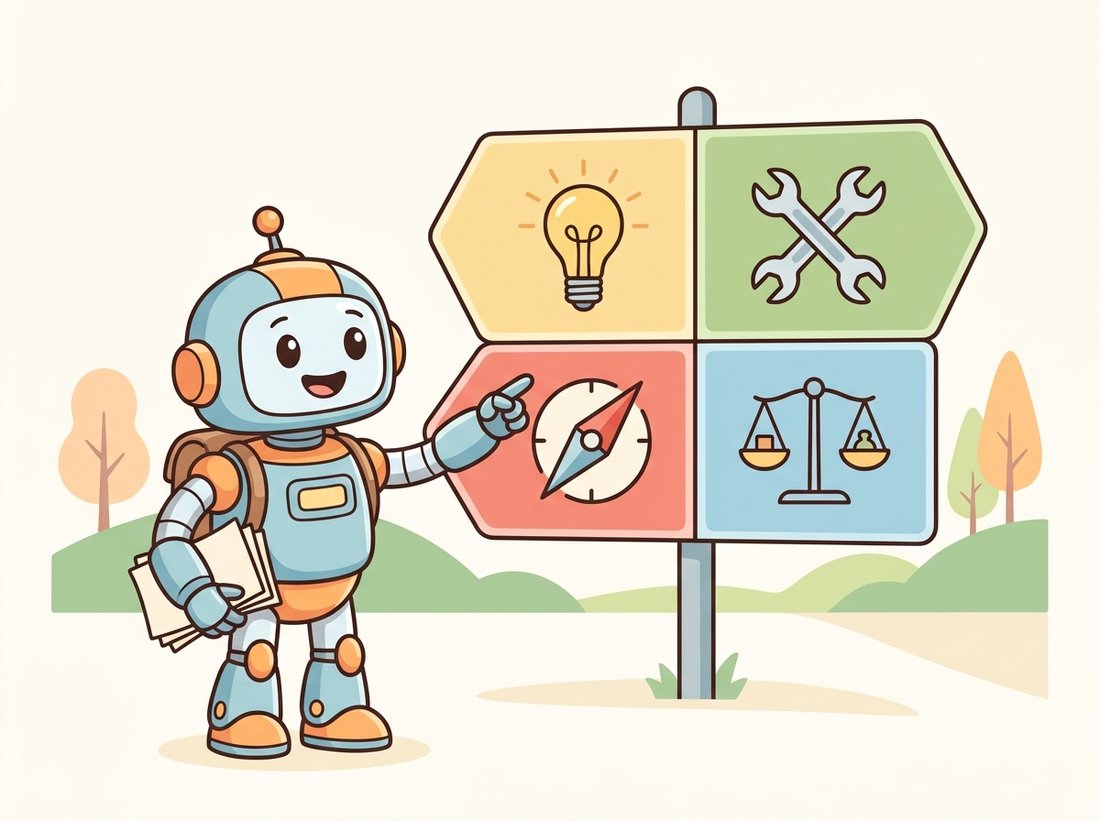
The generative vision literature is large and grows weekly, but the questions you bring to it are few. Figure 38.4.1 organizes the field into four quadrants by the question being asked, and the rest of this section walks each one. Use the map as an index: locate your question, then read the two or three durable sources under it before chasing the latest preprint. The illustration below shows the same idea as an explorer choosing a direction at a four-way signpost.
2. What Is the Idea? Foundations Intermediate
When you want to understand a generative method rather than just run it, go to the originating paper and one of the open textbooks for context. The lineage of Part IV is compact, and each idea has a home chapter in this book to read alongside its paper: variational autoencoders (Kingma and Welling, 2013; Chapter 31), generative adversarial networks (Goodfellow et al., 2014; Chapter 32), denoising diffusion (Ho et al., 2020; Chapter 33), latent diffusion (Rombach et al., 2022; Chapter 34), diffusion transformers (Peebles and Xie, 2023), and the flow-matching objective behind the current generation. The two open texts named in the chapter index, Prince's Understanding Deep Learning and Murphy's Probabilistic Machine Learning: Advanced Topics, give the conceptual scaffolding that the papers assume. Read the text chapter first for the framing, then the paper for the detail.
For a fast-moving area, the efficient path is a recent survey or one of the open-text chapters first, for the map and the vocabulary, then the two or three primary papers it cites as turning points. Diving straight into the newest preprint without the framing wastes time, because the preprint assumes you already hold the map. The open textbooks are the most durable map of all; a 2020 diffusion paper will read very differently after the relevant chapter of Prince or Murphy than before it. This is the same discipline as scouting published baselines before running your own: stand on the existing synthesis rather than rebuilding it.
A working rule of thumb in generative vision: the number of papers worth reading on a topic grows like the logarithm of the number published. Diffusion has thousands of papers and perhaps a dozen you must read; the rest are deltas on those dozen. The skill the map teaches is not reading more, it is recognizing the dozen, so you can skim the thousands with a clear conscience and a good map of where each delta attaches.
3. How Do I Run It? Libraries and Docs
When the question is operational, how do I load this, swap that, fit it on my GPU, the source is documentation and repositories, not papers. This is the quadrant the first three sections of this chapter live in: the Diffusers, PEFT, and Accelerate docs for the Python stack (Section 38.1), the ComfyUI repository and example workflows for the node stack (Section 38.2), and the provider docs for hosted APIs (Section 38.3). A practical habit that keeps this current is to pin the library version you are reading docs for, because the generative libraries move fast enough that a method signature can change between minor releases. The snippet below shows the one-line check that has saved more debugging time than any single doc page.
# Before trusting a doc page or a tutorial, confirm the versions you run.
# Generative libraries move fast; a tutorial may target an older API.
import diffusers, transformers, peft, accelerate
for lib in (diffusers, transformers, peft, accelerate):
    print(f"{lib.__name__:>12}  {lib.__version__}")
# diffusers   0.38.0
# transformers   5.11.0
# peft   0.19.1
# accelerate   1.13.0
Pinning versions is the reproducibility discipline of the deep-vision stack in Chapter 29 applied to documentation: a result, or a snippet, is only reproducible against a known environment. When a documented call does not behave as written, the first suspect is a version mismatch, and this one-line check rules it in or out before you go hunting for a deeper cause.
4. How Do I Judge It? Metrics and Benchmarks
When the question is whether one generator is better than another, or whether your fine-tune helped, the sources are the metric papers and the benchmark datasets, the subject of Chapter 37. The Frechet Inception Distance (Heusel et al., 2017) compares the statistics of generated and real images in a feature space, the generative descendant of the simple histogram and image statistics of Chapter 8 and the distribution thinking that began in Part I. Kernel Inception Distance is its lower-bias cousin; CLIPScore measures prompt adherence using the CLIP embeddings from Chapter 25; and human evaluation remains the gold standard the automatic metrics approximate. The durable lesson from this quadrant is that no single number captures generation quality, so read the metric papers to know what each number does and does not measure before you report it.
The chapter index calls FID the metric tool comparisons "lean on", and it is easy to read that as: a lower FID means each image is prettier, so I can score one generated image with it. Both halves are wrong. FID is a distribution-level statistic: it fits a Gaussian to the Inception features of a large sample of generated images (thousands, typically) and another to a sample of real images, then measures the Frechet distance between those two Gaussians. It has no value for a single image, and it says nothing about whether an image matches its prompt, which is what CLIPScore measures. A model can post an excellent FID by producing a realistic-looking set while individual samples are bland or ignore the prompt entirely; conversely one stunning image cannot move it. When you want to judge a single output or prompt adherence, FID is the wrong instrument, and reporting an FID computed on a handful of images is a number not comparable to any published one.
FID is subtle to implement correctly: you must use the exact Inception feature layer, the right image resizing, and a numerically stable matrix square root, and a small deviation in any of these produces a number that is not comparable to published values. Rather than reimplement it, use a maintained library such as torchmetrics (its FrechetInceptionDistance class) or the widely cited clean-fid package, both a few lines to call. The library handles the feature extraction, the resizing convention, and the stable computation, exactly the details that make a hand-rolled FID silently wrong. As Chapter 37 stresses, comparability is the whole point of the metric, and only a standard implementation gives it.
5. Where Is It Going? Staying Current
The fourth quadrant is the one no static list can fill, because it is about next month. The durable skill is a workflow for staying current rather than a set of links. Follow the official release notes and changelogs of the core libraries (they announce the new models as loadable components, per the frontier note in Section 38.1); watch the model hubs for trending checkpoints; read the survey trails that established researchers maintain; and treat the latest preprint as a lead to verify, not a fact to adopt. The 2024-2026 directions to watch, named across this chapter, are few-step distilled models, transformer-backbone and flow-matching architectures, video and 3D generation from Chapter 36, and multimodal generation behind a single interface.
A small team shipping a generation feature was spending a week each quarter evaluating whether to adopt the latest model everyone was posting about, usually concluding the integration cost was not worth the marginal quality gain. A new engineer changed the habit: instead of tracking individual model hype, the team subscribed to the Diffusers release notes and the model hub's trending page, and reviewed them for fifteen minutes every other week. The payoff was concrete. When a few-step distilled model landed as a loadable scheduler-and-adapter (the kind of change the Section 38.1 frontier note describes), they saw it in the changelog, recognized that it dropped their per-image latency and cost without a model migration, and adopted it in an afternoon, because it was a component swap, not a rewrite. The lesson is that staying current is a lightweight habit aimed at the right sources (the changelogs and hubs that surface adoptable changes), not a heroic effort aimed at every preprint.
6. How to Use This Map
The map is meant to be entered by question, not read front to back. Identify which of the four quadrants your need falls in, what is the idea, how do I run it, how do I judge it, where is it going, then go to the smallest set of sources under it: a paper and an open-text chapter for ideas, a doc page and a repo for operations, a metric paper and a standard implementation for judgment, and a changelog plus a hub for currency. The chapter index carries the annotated bibliography cards; this section tells you which card to reach for and why. Across the whole map the same discipline recurs, the one this book has applied in every Tools-of-the-Trade chapter: stand on the existing, durable source before building or chasing the new one.
The most striking recent trend in the literature is convergence: the separate lineages of Part IV are merging. Score-based diffusion and continuous normalizing flows met in the flow-matching framework (Lipman et al., 2022, arXiv:2210.02747; the rectified-flow line of Liu et al., 2022, arXiv:2209.03003) that now underlies several flagship models, collapsing what were two quadrants of the old map into one. Image, video, and 3D generation increasingly share a transformer backbone and a single conditioning interface, so a 2025 paper on video generation reads as a direct extension of a 2023 image-DiT paper rather than a separate field. And the world-model line from Chapter 36 ties generation to prediction and control, pulling in the self-supervised and predictive-representation work from Chapter 25. For the reader, this convergence is good news: the foundational papers in the "what is the idea" quadrant are becoming more, not less, durable, because the same handful of ideas, denoising, latent representations, transformers, flow, now explain a widening range of systems. The map gets simpler even as the field gets bigger.
7. Summary and a Closing Word
The literature of Part IV is best entered by question: foundational papers and open texts for the idea, library docs and repos for running it, metric papers and benchmarks for judging it, and changelogs and hubs for staying current. Use a standard implementation for metrics, pin your library versions before trusting a doc, and treat the latest preprint as a lead to verify. The recurring discipline is to stand on durable sources before chasing new ones. This closes Chapter 38, Part IV, and the book. You began at the pixel in Part I, learned to find structure in it classically in Part II, learned to recognize it with deep networks in Part III, and learned to generate it in Part IV. The convolution you wrote by hand in Chapter 3 is now the denoiser inside a diffusion model you call through a pipeline. The next step is the capstone, where all four parts meet in one project.
For each of the following needs, name which of the four quadrants in Figure 38.4.1 it belongs to and the kind of source you would consult first: (a) understanding why flow matching is considered a generalization of diffusion; (b) finding out which call attaches a LoRA in the current Diffusers version; (c) deciding whether your fine-tuned model actually improved over the base; (d) learning what new video models landed this month. Explain in one sentence per item why that quadrant is the right entry point.
Extend the version-check snippet in this section into a small function environment_record() that returns a dictionary of the installed versions of diffusers, transformers, peft, accelerate, torch, and the CUDA version reported by torch.version.cuda, and writes it to a JSON file alongside any generated output. Explain in two or three sentences how attaching this record to your results implements the "pin your versions" reproducibility discipline, and how it would let a colleague diagnose a snippet that "worked on your machine".
Choose one topic from Part IV you want to go deeper on (for example latent diffusion, ControlNet, video generation, or FID). Using the four-quadrant structure of this section, assemble a personal reading map for that topic: one foundational paper, one open-text chapter or survey, one library doc or repo, and one current source (a changelog, hub page, or recent preprint). Write a sentence for each explaining what question it answers and why it earns a place over alternatives. The result is a one-page guide you could hand to a teammate starting on the same topic.