"The scene had twenty stops of dynamic range. I had eight bits. We compromised: I clipped."
A Permanently Clipped Highlight
A digital image has three separate budgets, routinely confused with one another: resolution (how many pixels), bit depth (how many intensity levels per pixel), and dynamic range (how wide a span of real-world brightness those levels cover); any one of the three can be the bottleneck, and adding to the wrong one buys nothing. A billboard-sized image can still posterize, a 16-bit file can still be blurry, and a sharp, smooth image can still have its highlights burned to pure white. This section teaches you to diagnose which budget is short and how to spend wisely on each.
Carry one schema out of this section. Each budget answers its own question, carries its own unit, and fails in its own way: resolution is pixels (how many samples; fails as blur), bit depth is levels (how many steps per pixel; fails as banding), and dynamic range is span (how wide a brightness interval; fails as clipping). The diagnostic habit that follows: when an image disappoints, ask which of the three is short before spending on any of them, because adding to the wrong budget buys nothing. Blur, banding, clipping: three symptoms, three budgets, one for each. The three-jars illustration below fixes the schema in memory.
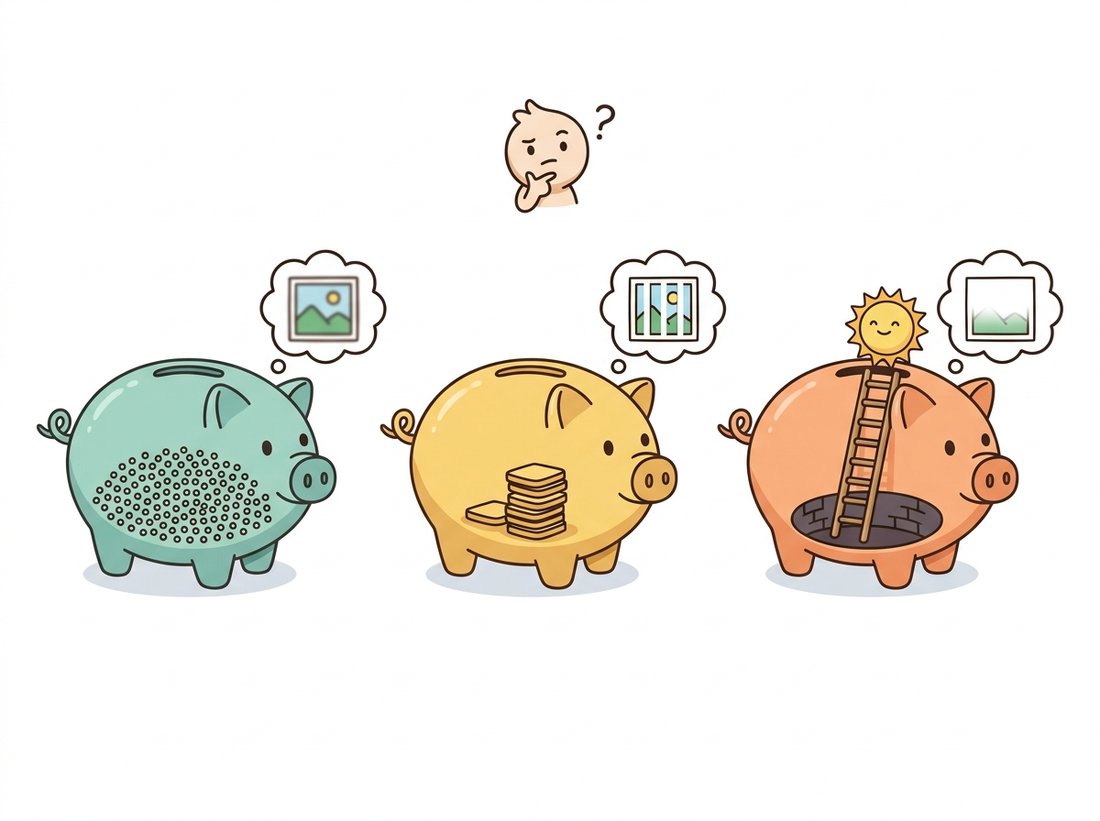
Buy the camera with twice the megapixels and your blurry images stay blurry; pay for 16 bits and your clipped highlights stay clipped. By the end of this section you will read a datasheet and know exactly which number to spend on. The two discretizations from Section 1.2, sampling and quantization, become the first two of three concrete specifications printed on every camera datasheet and every dataset card; the third is the one those discretizations still miss: dynamic range, the question of what physical brightness interval your numbers span. The three budgets map cleanly onto the previous section's theory: resolution is your sampling budget, bit depth is your quantization budget, and dynamic range is where you choose to aim them.
1. Spatial Resolution: More Than Megapixels Beginner
Resolution colloquially means pixel count, but the useful engineering definition is resolving power: the finest real-world detail the whole system can distinguish. The two diverge constantly. As computed in Section 1.1, diffraction at f/8 blurs a point into a disk wider than three phone-sensor pixels; through that lens, extra megapixels sample blur, not detail. Optics, focus accuracy, motion, atmospheric shimmer, and the demosaicing interpolation all cap resolving power below the pixel count. Lens and system sharpness is measured by the modulation transfer function (MTF), which reports how much contrast survives at each spatial frequency; system MTF is the product of every stage's MTF, so the weakest stage dominates.
That product rule has a vivid consequence worth working through slowly. Picture the contrast of a fine pattern as a relay race where each stage hands on a fraction of what it received: if the lens passes 0.7 of the contrast at some frequency, the sensor 0.8, and the demosaicer 0.5, the system passes $0.7 \times 0.8 \times 0.5 \approx 0.28$, barely a quarter. Upgrading the 0.8 sensor to a flawless 1.0 lifts the chain only to 0.35, while fixing the 0.5 demosaicer to 0.9 nearly doubles it; chasing any number but the smallest one is wasted money. Figure 1.3.1 traces this contrast relay stage by stage.
For scene understanding, the more actionable number is ground sample distance or its indoor cousin, pixels-per-object: how many pixels land on the thing you care about. Detection models do not need a 48-megapixel frame; they need enough pixels on target. A face recognizable to a human at roughly 30 pixels of eye-to-eye distance, a license plate readable at roughly 16 pixels of character height, a weld defect at 5 pixels of width: capacity planning for vision systems is the art of guaranteeing pixels-on-target, then choosing sensor and lens to deliver them. Meanwhile, classification networks routinely operate at 224×224 because, after the augmentation and resizing pipelines of Chapter 21, that is where their accuracy-compute tradeoff has historically settled.
A common belief is that a higher-resolution sensor (or upscaling an image to a larger size) always gives a vision system more to work with. In fact, resolving power is capped by the weakest stage of the whole system: once diffraction, defocus, motion blur, or demosaicing has already blurred a feature, extra pixels sample that blur more finely without adding information, and upscaling a small image invents nothing the sensor never recorded. What helps a model is pixels-on-target on a sharp, well-exposed feature, not raw megapixels; a 224x224 crop with the object filling the frame beats a 48-megapixel frame where the object spans 12 soft pixels. Spend the resolution budget where the optics can actually deliver detail.
The megapixel race has quietly run backwards at the high end: flagship phones advertise 200-megapixel sensors, then ship firmware that bins 16 photosites into one output pixel by default and hands you a 12-megapixel photo with better noise. The number on the box and the number doing the work live on the same chip, off by a factor of sixteen, and the smaller one usually wins.
2. Bit Depth: Levels, Headroom, and Windowing Intermediate
Bit depth sets the quantization ladder from Section 1.2: $2^b$ levels, roughly 6 dB of signal-to-noise per bit. Eight bits suffice for final display of a single rendered image. The case for more bits is headroom for computation. Every brightness adjustment, gamma change, or contrast stretch (the point operations of Chapter 2) re-spaces the levels; in an 8-bit pipeline, stretching a dim region multiplies its quantization gaps into visible bands. Editing in 16-bit or float and converting to 8-bit once, at the very end, avoids accumulating that damage. The same logic is why we recommended float32 as the working dtype in Chapter 0.
The clearest demonstration of bit depth as a budget is medical-style windowing. A CT scanner produces 12-bit data: 4096 levels spanning air to dense bone. Tissue differences a radiologist needs may be 20 levels apart, invisible when 4096 levels are crushed into 256. The fix is not more display bits; it is spending the 8 display bits only on the diagnostically relevant band. Code 1.3.1 builds a synthetic 12-bit image with a faint blob and shows the blob appear when windowed.
import numpy as np

rng = np.random.default_rng(seed=3)

# Synthetic 12-bit "scan": background tissue near level 2048 (sigma 60),
# plus a faint blob just +25 levels brighter, far below visual threshold
# after naive 8-bit conversion.
img12 = rng.normal(2048, 60, size=(256, 256))
yy, xx = np.mgrid[0:256, 0:256]
img12 += 25 * np.exp(-((xx - 170) ** 2 + (yy - 90) ** 2) / 400.0)
img12 = np.clip(img12, 0, 4095).astype(np.uint16)

blob_patch = (slice(80, 100), slice(160, 180))   # on the blob
back_patch = (slice(80, 100), slice(20, 40))     # plain background

# Naive 8-bit conversion: squeeze ALL 4096 levels into 256.
naive8 = (img12 // 16).astype(np.uint8)
print("naive  blob-background contrast:",
      round(float(naive8[blob_patch].mean() - naive8[back_patch].mean()), 1))

# Windowed conversion: spend all 256 levels on the 1900..2200 band.
lo, hi = 1900, 2200
win = np.clip((img12.astype(np.float32) - lo) / (hi - lo), 0, 1)
win8 = (win * 255).astype(np.uint8)
print("windowed blob-background contrast:",
      round(float(win8[blob_patch].mean() - win8[back_patch].mean()), 1))
naive  blob-background contrast: 1.6
windowed blob-background contrast: 21.2
3. Dynamic Range: The Span Between Noise and Clipping Intermediate
Dynamic range (DR) is the ratio between the brightest and darkest signals a system can represent usefully in the same image: bounded above by clipping (the full well of Section 1.1) and below by the noise floor. It is quoted as a ratio, in decibels, or most intuitively in stops (factors of two):
$$\mathrm{DR}_{\text{stops}} = \log_2 \frac{I_{\max}}{I_{\min}}, \qquad \mathrm{DR}_{\text{dB}} = 20 \log_{10} \frac{I_{\max}}{I_{\min}}.$$The factor of 20 rather than the 10 from Section 1.2 is not a contradiction: dB is always defined on power, and these intensities are amplitude-like quantities whose power goes as the square, so $10 \log_{10}(\text{ratio}^2) = 20 \log_{10}(\text{ratio})$.
The engineering problem is a mismatch of spans, which Figure 1.3.2 lays out. A sunlit street with open shade spans roughly 17 to 20 stops. A good modern sensor captures 12 to 14 stops in one exposure; a phone sensor closer to 10. An 8-bit file holds 256 linear levels, about 8 stops between its smallest and largest codes (gamma encoding, covered in Chapter 2, spaces those codes perceptually but cannot widen the captured span). Something has to give: either highlights clip, shadows drown in noise, or the tones are compressed nonlinearly to fit.
4. HDR Capture: Widening the Bar Advanced
If one exposure cannot span the scene, take several. A short exposure preserves the highlights; a long one digs detail out of the shadows; intermediate ones cover the middle. High dynamic range (HDR) imaging merges the stack, using each pixel from whichever exposures rendered it best. Code 1.3.2 simulates a full bracket-and-merge round trip with no input files: it builds a synthetic radiance map spanning roughly 13 stops, "photographs" it at three exposure times through the clip-and-gamma pipeline of Section 1.1, and fuses the bracket with Mertens exposure fusion, which weights each pixel by how well exposed it is.
import cv2
import numpy as np

# Synthetic scene RADIANCE (linear light), spanning ~13 stops:
# a dim interior, a deep-shadow corner, and a blazing window.
h, w = 360, 480
yy, xx = np.mgrid[0:h, 0:w].astype(np.float32)
radiance = 0.02 + 0.08 * (xx / w)              # interior, gently brightening
radiance[60:180, 300:440] = 40.0               # window: 500x the interior
radiance[200:320, 60:200] = 0.004              # shadow corner

def expose(rad, t):
    """One camera exposure: scale by time, clip the well, gamma-encode."""
    linear = np.clip(rad * t, 0.0, 1.0)
    return (255.0 * linear ** (1 / 2.2)).astype(np.uint8)

times = [1 / 64, 1.0, 16.0]                    # 10-stop bracket
stack = [cv2.cvtColor(expose(radiance, t), cv2.COLOR_GRAY2BGR)
         for t in times]

fused = cv2.createMergeMertens().process(stack)   # float32, ~[0, 1]
fused8 = np.clip(fused * 255, 0, 255).astype(np.uint8)

for t, s in zip(times, stack):
    print(f"t={t:>7}: clipped {(s == 255).mean():5.1%},"
          f"  near-black {(s <= 5).mean():5.1%}")
print(f"fused   : clipped {(fused8 == 255).mean():5.1%},"
      f"  near-black {(fused8 <= 5).mean():5.1%}")
t=0.015625: clipped  0.0%,  near-black  9.7%
t=    1.0: clipped  9.7%,  near-black  0.0%
t=   16.0: clipped 46.9%,  near-black  0.0%
fused   : clipped  0.0%,  near-black  0.0%
In Code 1.3.2, edit the single line times = [1/64, 1.0, 16.0] and rerun, reading only the printed clipped and near-black percentages. First collapse it to one exposure (times = [1.0]) and confirm the fused result now clips or crushes just like a single shot: fusion cannot invent range a bracket never captured. Then widen it (times = [1/256, 1.0, 256.0]) and watch both failure percentages on the fused row fall toward zero. Finally narrow the spread to nearly identical exposures (times = [0.5, 1.0, 2.0]) and see the shadow or highlight failure return even with three frames. The lesson lands in the numbers: what matters is not how many exposures you take but whether the span between the shortest and longest actually brackets the scene's dynamic range.
True radiometric HDR (recovering a physical radiance map, not just a nice-looking fusion) requires estimating the camera response curve from the bracket and inverting it, the algorithm of Debevec and Malik (1997): around 150 lines of careful least-squares if written by hand. OpenCV ships the whole pipeline:
# Recover a physical radiance map from the same bracket: estimate the
# camera response curve, merge to HDR, then tone-map back to a display image.
times_np = np.array(times, dtype=np.float32)
response = cv2.createCalibrateDebevec().process(stack, times_np)
hdr = cv2.createMergeDebevec().process(stack, times_np, response)  # float32 radiance
ldr = cv2.createTonemapReinhard(gamma=2.2).process(hdr)            # display version
cv2.Who: A perception engineer at an automotive ADAS supplier.
Situation: The lane-keeping camera performed flawlessly on highways and in tunnels, each taken separately.
Problem: At tunnel exits on sunny days, the scene contained both a dark interior and sunlit pavement, around 18 stops together. The auto-exposure chose the middle: for 1 to 2 seconds, the exit was a white clipped blob with no recoverable lane markings, and lane-keeping silently degraded exactly when the driver was least prepared.
Decision: The team specified an HDR automotive sensor (multi-exposure capture with on-chip merging, 120 dB class) and moved exposure control from full-frame average metering to a road-region weighting.
Result: Lane-detection availability through tunnel transitions rose from 71% to above 99% in validation drives; the incident class disappeared from the disengagement reports.
Lesson: Dynamic range failures are scene-dependent and intermittent, the worst kind of bug. Datasheet DR must be checked against the worst scene the product will face, not the average one.
5. The Budgets Meet Machine Learning Intermediate
Vision models inherit all three budgets through their training data. Resolution determines pixels-on-target and thus the detectability floor for small objects. Bit depth interacts with normalization: the standard practice of scaling images to $[0, 1]$ or standardizing with dataset statistics, which we will formalize in Chapter 21, silently assumes the input levels are perceptually spaced 8-bit values; feeding 12-bit linear data through the same constants wrecks the input distribution. Dynamic range determines what is in the data at all: a model trained on tone-mapped JPEGs has never seen the clipped-highlight failure mode of its deployment camera, and restoration methods from Chapter 7 cannot reconstruct what was never recorded. When you control the capture stack, record the widest range you can and compress late; when you do not, audit the data for clipping before you blame the model.
Noise can be averaged, blur can be partially deconvolved, banding can be dithered, and color casts can be corrected, all with bounded success. Clipped values are different in kind: every scene brightness above the threshold mapped to the same number, and no algorithm can tell which one it was. Generative models can hallucinate plausible content into clipped regions, but for measurement and safety systems, plausible is not the same as true. Protect the highlights at capture time; everything else has a remedy.
After two decades as a photography niche, scene-referred HDR is becoming infrastructure. The gain-map approach (a standard JPEG plus a small map saying how much to brighten each region on capable displays) shipped as Ultra HDR in Android 14 and as Adaptive HDR on iPhones, and was standardized as ISO 21496-1 in 2025, giving the industry a backward-compatible HDR file format at last. On the sensor side, automotive and surveillance imagers now combine split-pixel designs (a large and a small photodiode per pixel) with dual conversion gain to exceed 120 dB in a single frame, with LED-flicker mitigation as a 2024 to 2026 research focus. And inverse tone mapping, reconstructing HDR from legacy SDR content with diffusion-based generative priors, is an active 2024 to 2026 topic for restoring film archives and training data alike, directly continuing this chapter's theme that what the pipeline discarded, learned models now try to guess back.
We now have the image's geometry (resolution), its level ladder (bit depth), and its physical span (dynamic range). The remaining unexplained axis of the array from Chapter 0 is the channel dimension: what the three numbers per pixel mean. That is color science, the subject of Section 1.4.
For each complaint, name the short budget (resolution, bit depth, or dynamic range) and justify briefly: (a) a parking camera cannot read plates beyond 20 meters even in perfect light; (b) a sky-replacement app produces ring-like contours in smooth sunset gradients after editing; (c) an indoor robot is blinded for two seconds whenever it faces a window; (d) barcodes scan reliably, but only when held at one specific distance.
Extend Code 1.3.1 into an interactive tool: load any 16-bit image (or generate the synthetic scan), and bind two keyboard keys to shift the window center and two to change its width, re-rendering the 8-bit view each keypress with OpenCV's imshow. Add an on-screen readout of the current window. Then find the narrowest window at which the synthetic blob is reliably visible and report it as a fraction of the full 12-bit range.
Modify Code 1.3.2 to sweep bracket sizes: 1, 2, 3, 5, and 7 exposures spanning the same 10-stop range. For each, compute the fraction of pixels that are clipped or near-black in the fused result, and the mean absolute error between the fused image and an ideal tone-mapped reference built directly from the radiance map. Plot both curves against bracket size and identify the point of diminishing returns. How does your answer change if you add photon shot noise from Code 1.1.1 to each exposure?